I’m talking about 70,000 chopsticks. All recycled. All given a longer second life. All saved from reaching landfills.
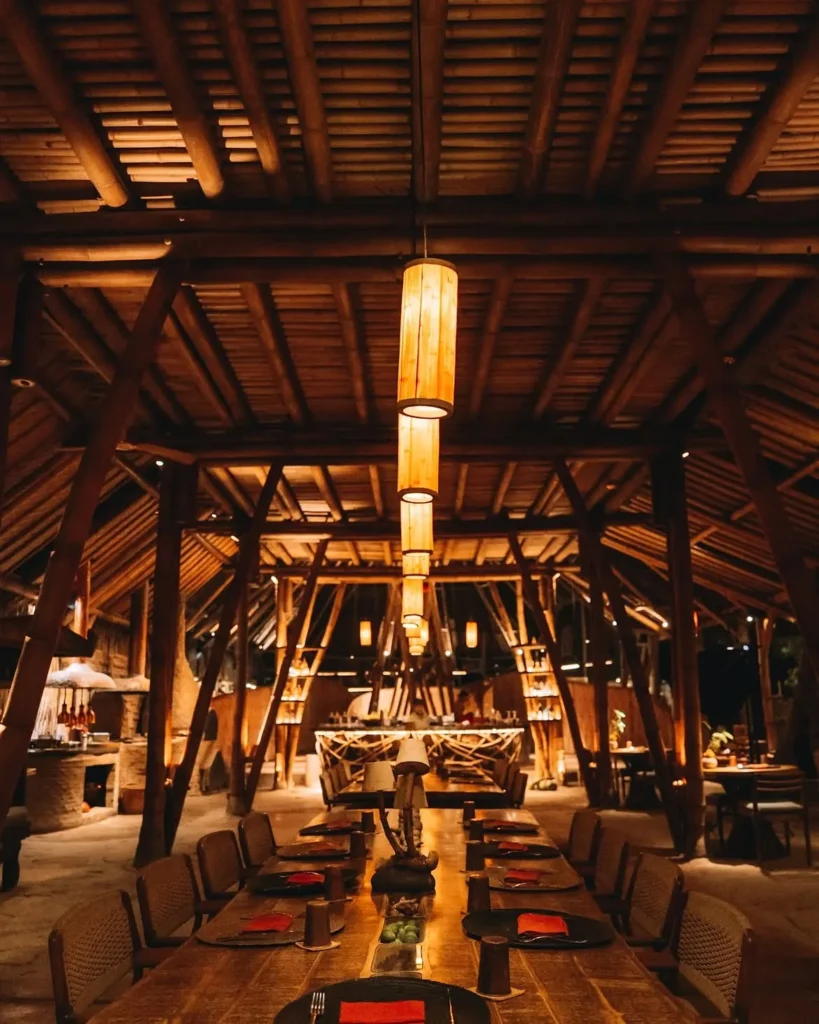
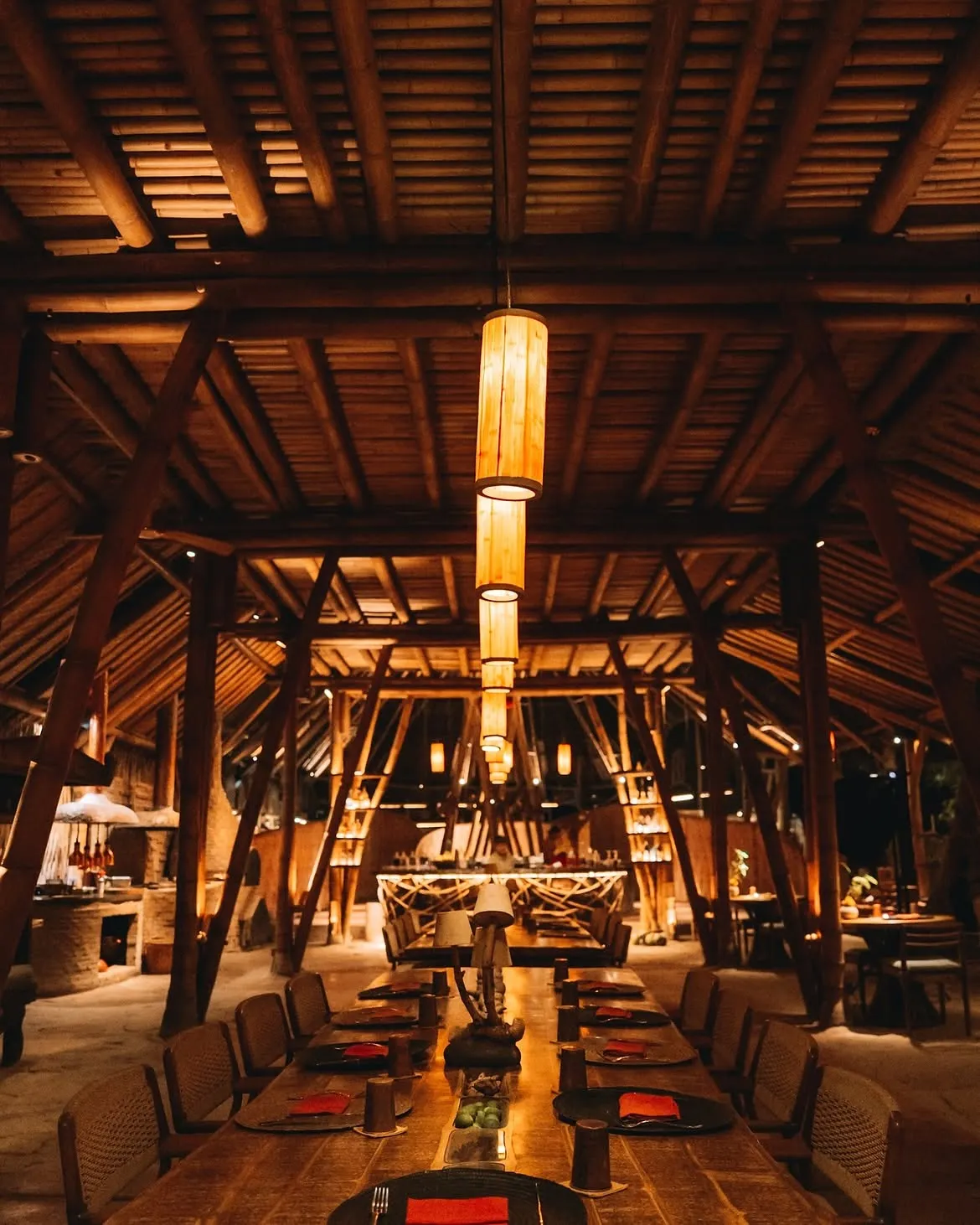
An end-grain pattern on an 8-meter communal dining table. That’s what the Longevity Table at Tembaga carries so very authentically in its personality.
Run your fingers along the surface of the dining table, and you’ll find it remarkably cool and dense.
Unlike the concentric rings of teak or the pale, uniform lines of oak, the patterns show tiny dots in similar shades running edge to edge. This is owed to the vertical placement of the chopsticks, with the end grain facing up. None of the materials was cut from an ancient tree. We gathered them from the tables of local noodle shops and warungs across Bali.
I’m talking about 70,000 chopsticks. All recycled. All given a longer second life. All saved from reaching landfills.
Thanks to ChopValue Bali and my son, Orin Hardy, these discarded bamboo sticks were collected and pressed together to be the centre of attraction at Tembaga’s longevity cuisine label.
Also, my daughter Carina Hardy has outdone the sense of modern design by using handcrafted copper accents that give Tembaga its name. Look how it pairs raw copper with the recycled bamboo table.
And no part of Tembaga would be so cosy without the structural bamboo architecture crafted by my beloved daughter, Elora Hardy, and her team at IBUKU.
Treat Trash Right, Build Materials
Millions of single-use bamboo chopsticks are split apart every day. 20 minutes of swirling in a bowl of mie goreng or ramen, and it’s then considered “waste”. That’s how most of today’s generation sees a used chopstick: as garbage.
But Orin and his team see these sticks in a different light. They respect it as mature, high-density bamboo fibre that spent three to five years pulling in carbon and minerals from the earth.
Throwing that material away after a single meal is a sheer waste of natural resources. It’s even also a failure of human design imagination.
Realising this was enough to use the chopsticks for another waste-to-resource project at Bambu Indah’s dining area.
Not to forget, bamboo is among nature’s most incredible structural grasses. Its natural strength can rival steel and outpace many traditional hardwoods.
Some harvest a bamboo culm and process it into tiny eating utensils. Others burn or bury it twenty minutes later. I think this treats high-value biological engineering as cheap refuse.
What’s interesting is that bringing those discarded chopsticks back into our immediate ecosystem is deceptively simple. But it requires rethinking how we manage local waste streams.
Our local teams partnered with 100s of restaurants across the island. We’ve set up a hyper-local chain of collection bins. Rather than diverting used chopsticks to open burn piles, we steam-sanitised and dried them using low-energy systems. We wanted to keep the material’s purity intact. It’s a non-negotiable.
Another important step was using non-toxic binders to evolve the chopsticks into sustainable tiles. Heat and hydraulic pressure did the job of fusing individual bamboo fibres into dense tiles.
Notice how the chopsticks were first urban refuse. Then they were destined to decay in a landfill. But green-building concepts turned it into a water-resistant and high-performance table that can stand the test of time.
Proof of Material and Human Longevity on One Table
Placing this table at the centre of Tembaga was our main intent.
Being Bambu Indah’s longevity kitchen, Tembaga is a space mindfully and sustainably designed around clean food brimming with anti-inflammatory compositions. Each morsel is chosen to complete a menu of restorative food options.
Slow cooking keeps the original nutrient profile alive and honours the body’s natural biological cycles. We even grow the ingredients directly in our permaculture beds at The Kul Kul Farm.
In a nutshell, the culinary philosophy strikes out refined seed oils and any industrial processing. It focuses on how clean, nutrient-dense inputs help our cells flourish and endure over a lifetime.
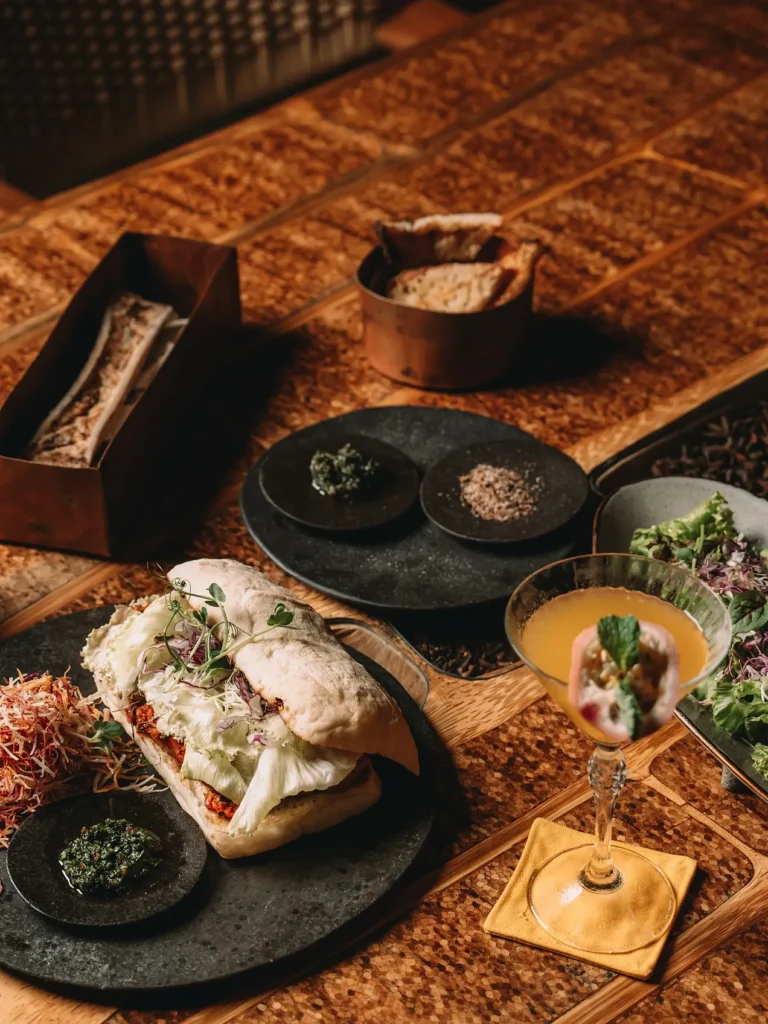
It only made sense that the table hosting these meals should feel and communicate the same way.
Seeing this happen at every meal at Tembaga fulfils our dream. Learners, travellers, teachers, guests, families, wellness practitioners – for everyone, the conversation naturally flows from abstract sustainability toward a lived reality.
You look down at your plate. Then beneath at the table. You get the sweet reminder that longevity is a personal health goal. You also have a lightbulb moment and realise that it’s a design framework for everything we touch.
A very clear principle of harmony resonates here. It shows that human bodies will continue to live long, healthy lives. But only if we keep building living environments from materials treated with that same long-term respect.
Keep in mind that the Longevity Table does phenomenally well at showing us the circularity concept. We may see it as a compromise on luxury, or a sacrifice of convenience. But it’s actually about giving everyday objects a second life that outlasts their first by decades.
I recommend looking at how ChopValue Bali fits into the larger family ecosystem alongside Bamboo U and IBUKU. That’s the power of this collaboration.
Our years of work with bamboo have helped us build large-scale architectural structures. Floors-high pavilions. Curved bamboo arches. Multi-story structural homes.
However, I like to believe that macro architecture is only half the equation. A truly sustainable society must end the micro-waste problem. This includes the small, daily items that circulate through our homes and streets by the millions.
That’s why ChopValue Bali has partnered with Bamboo U and set up a micro-factory model right here in Ubud. It won’t take you long to understand how localised recycling has a great output, that too without huge carbon footprints.
- Waste is harvested from local warungs rather than importing raw timber from distant forests. The embodied carbon of the final product remains exceptionally low in such supply chains.
- Tens of thousands of individual chopsticks are compressed into a single dining table surface and other furniture. This keeps such organic matter out of landfills where it would otherwise release harmful methane gas.
- Burning discarded bamboo or letting it rot will release its stored carbon back into the atmosphere. We’d rather press it into durable furniture to lock that carbon inside the product for generations.
The Sustainable Way Rests in Your Perspective of Everyday Items
Nature won’t hurry. Neither will it create garbage. Natural forests often prove these statements. Fallen leaves feed the fungal mycelium in the soil. Fallen trunks become a nursery for seedling trees. Discarded shells shelter new organisms.
What excites me about Tembaga’s Longevity Table is the network of local hands that made it possible. It’s material evidence that we don’t need faraway supply chains or heavy carbon footprints to solve our micro-waste problem.
Most solutions are already on our dining plates and circulating through our local streets.
If you enjoyed reading this, subscribe to Green by John. We’ll share what we’re exploring, reading, building, and discovering as we go.